
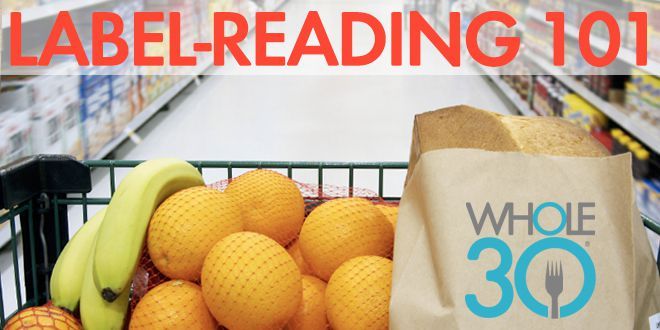
You’ve committed to the Whole30. You’ve read the Whole30 Program Rules, and you’re ready to hit the grocery store to stock your fridge and pantry. You start with ground beef, chicken thighs, salmon, and eggs—check. Time for produce—so easy! Every color of the rainbow goes in your cart in the form of fresh vegetables and fruit. You’re cruising!
Then you hit the aisles, and your Whole30 momentum comes to a screeching halt. It’s time to start label-reading, and that can feel intimidating. Don’t panic! Today we’re going to help you develop your label-reading skills so you can breeze through the aisles with ease.
Step 1: Read the Whole30 Program Rules
You’ve read the Whole30 rules. You know the elimination phase means no added sugar, grains, dairy, and beans. You’ve got this, right? But what about quinoa? Edamame? Monk fruit? What the heck are those?
If you’re not sure what an ingredient is, Google! Then compare the ingredient against the Program Rules and the Fine Print. (Answer: Quinoa is a grain, edamame are soybeans, and monk fruit is a sweetener. These three ingredients are all out during Whole30 elimination, and all of them are specifically mentioned in the Program Rules.)
Keep the rules handy, as you’ll be consulting them often, especially in the beginning. The more familiar you are, the easier it will be for you to read a label—any label, whether it’s a grocery store product, a Pinterest recipe, or a restaurant menu.
Step 2: Read the Allergy Warning
Most people pick up a product and start reading the ingredients one-by-one. Instead, see if there’s take a shortcut available, and head straight to the allergy statement. That’s the bolded notation in the ingredient list itself, or the all-caps “CONTAINS” statement found on all USDA-approved foods. This warning clearly stating if the food contains one of the following 8 allergens: milk, eggs, fish, Crustacean shellfish, tree nuts, peanuts, wheat, and soybeans. If you see milk, peanuts, soy, or wheat, you immediately know the product isn’t a fit for the Whole30.
Note: You also might see terms like “processed in a facility that also processes…” or “manufactured on equipment that uses…”. This warning is used by food manufacturers if there is a possibility (however small) that the food may contain an allergen due to cross-contamination during production. Items on this label will NOT rule the product out for your Whole30.
Step 3: Read the Ingredient List
If there is nothing overtly specified in the allergy warning, it’s time to run through the ingredients carefully. Added sugar, artificial sweeteners, corn starch, or rice bran won’t be listed on an allergy warning, but will rule the product out for your Whole30 elimination.
Look for added sugar in surprising places (it’s everywhere). Look for wheat, soy, or other grains in pre-made foods like burgers, salmon patties, or frozen vegetable mixes. Read every label, including condiments, spice mixtures, and even tea! You may be surprised at what you’ll find, and you need to be extra-careful to avoid those ingredients during elimination.
Congratulations! You’re a Label-Reading Expert!
While it may seem tedious to read every single label, with practice, this will become second nature. Even after your Whole30 is over, you’ll find yourself scanning labels effortlessly and maintaining the habits you learned during your program.